

















INTEGRATED MANAGEMENT OF LANDBASED ACTIVITIES
IN THE SÃO FRANCISCO BASIN PROJECT
ANA/GEF/UNEP/OAS
Activity 2.2.B Recovering our Forests
Executive Summary of the Final Report
COMMUNITY-GOVERNMENT PARTNERSHIP AND
SOCIETY PARTICIPATION AS AN INSTRUMENT FOR
RECONSTITUTING RIPARIAN WOODS AND FOR
ENVIRONMENTAL CONSERVATION
ASF
Associação Ambientalista do Alto São Francisco
Luz MG
INTEGRATED MANAGEMENT OF LANDBASED ACTIVITIES
IN THE SÃO FRANCISCO BASIN PROJECT
ANA/GEF/UNEP/OAS
Activity 2.2.B Recovering our Forests
Executive Summary of the Final Report
COMMUNITY-GOVERNMENT PARTNERSHIP AND
SOCIETY PARTICIPATION AS AN INSTRUMENT FOR
RECONSTITUTING RIPARIAN WOODS AND FOR
ENVIRONMENTAL CONSERVATION
Subproject Coordination
Francisco José Soares
Associação Ambientalista do Alto São Francisco
Consultants
Fernando Antônio Sasdelli Gonçalves
Marília Queiroz de Rezende Nogueira
Contract CPR/OAS PO # 49632
November 2002
COMMUNITY-GOVERNMENT PARTNERSHIP AND SOCIETY
PARTICIPATION AS AN INSTRUMENT FOR RECONSTITUTING
RIPARIAN WOODS AND FOR ENVIRONMENTAL CONSERVATION
EXECUTIVE SUMMARY
INTRODUCTION
This Final Report describes the activities related to the mobilization and capacitation of the
Community of Luz, viewing the implementation of soil conservation practices and the production
of forest species` seedlings, for the reconstitution of riparian woods and formation of economic
forests. Activity 2.2.B (Recovering our Forests), part of the Component II (Sustainable
Development and Stakeholders Participation) of the Integrated Management of Land Based
Activities in the São Francisco River Basin Project (GEF/ANA/OAS/UNEP), has it headquarters
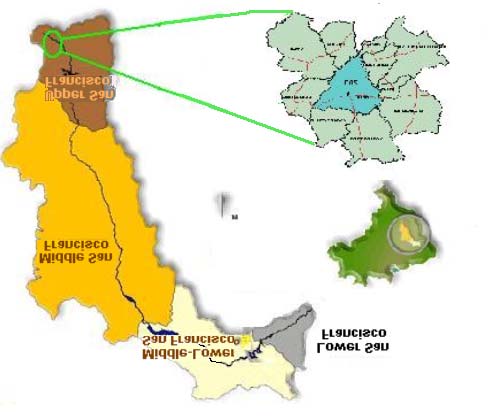
in the Municipality of Luz, in the State of Minas Gerais (Figure 1).
Figure 1. The Municipality of Luz, in the Upper São Francisco.
The first chapter in the Report contains the characterization of the region and the second covers
the mobilization of the community, with the involvement of the rural and urban populations. The
third chapter refers to capacitation, discussing elementary and high-school teachers, students and
farmers, as well as environmental topics. The forth one discusses the formation of forests, while
the fifth describes the implementation of conservation practices and the sixth analyzes the
strengthening of local organizations. Finally, the seventh and eighth present the conclusions and
recommendations, respectively.
i
1. CHARACTERIZATION OF THE MUNICIPALITY OF LUZ
The Municipality of Luz is located in the State of Minas Gerais, in the Upper São Francisco
Microregion, Central-Western macroregion of the State. With 1,175 km2, and with seat located in
19°47'51" S latitude and 45°41'14" W longitude, it is located to the left margin of the São
Francisco River. It is limited by the Municipalities of Bom Despacho, Moema, Santo Antônio do
Monte and Lagoa da Prata; to the East, by Iguatama, Japaraíba and Bambuí; to the South, by the
Danta Creek, to the West, and, finally, by Estrela do Indaiá and Dores do Indaiá, to the North.
The local climate may be classified as subsequent semi-humid tropical, according to Edmon
Nimer (IBGE, 1977:82). This means that the Municipality presents a typically tropical climate
with warm and rainy Summers and dry, but no so cold, Winters. Mean annual temperature is
21.4°C, with a minimum of 1.4°C and an absolute maximum of 36.0°C. The mean in the coldest
month is 17.5°C. The mean annual precipitation is 1,637 mm, concentrated mainly in the months
from November to February.
Among the numerous São Francisco tributaries in the Municipality, it is worth mentioning the
Bambui River, the Ribeirão São Mateus, which changes its name to Ribeirão Jorge Grande, in the
lower course, and the Córrego da Velha, which also changes to Ribeirão Jorge Pequeno, close to
the City of Luz.
The vegetation is characterized by several arborous ranges of the cerrado, varying according to
the soil type and local declivity, including fields, regular cerrados, wood formations, such as the
cerradão, and riparian woods. These vegetative covers, however, are almost totally without a
characterization, being mapped by IGA as areas under anthropic influence. The remaining wood
patches are almost completely concentrated in the protected areas (Permanent Protection Areas
and Legal Reserves).
Regarding the riparian woods in the São Francisco River Basin, degradation came to a point of
taking many species to almost total extinction. For many of those species, there are no longer
matrices for reproduction. It becomes necessary to import, from forest ranges or other reserves,
frequently making difficult the reconstitution efforts.
The riparian woods, originally existing along the water courses, today are almost completely
without characterization, as even those which have not yet been completely removed had their
density reduced. Only a few of the big trees remained, such as the fig trees. It is well known that
riparian woods are an important source of food for all the regional fauna, not only for those that
take shelter in their copa, such as birds and primates, but also for the river fish, which have their
fruits as source of food.
The most significant economic activity in Luz are related to agriculture and livestock raising,
which makes the Municipality the third greatest dairy producer in the State of Minas Gerais. The
current production techniques are usually rudimentary and inadequate for assuring a sustainable
development.
ii
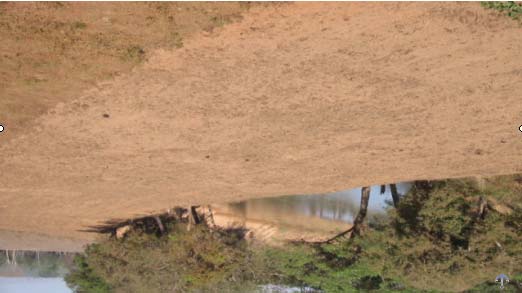
Picture 1. Degraded area in the margins of the São Francisco.
Coffee plantations and pastures cover legal reserves and permanent preservation areas. Planting
on slopes, associated with large soil movements and burnings with clearing purposes have eroded
and turned unproductive soils which were previously highly productive. To allow the
implemented actions to achieve a greater harmony with the productive activities and with the
conservation of natural resources, questioning the practices in the development model which did
not contemplate sustainability and the search for solutions to the many environmental and
sanitary problems in the rural area was encouraged.
In view of this picture, the proposal for recovering riparian environments and soils, in Luz (MG),
was born from the desire of the student community and rural class representatives, who begin to
notice the economic loss associated with the environmental degradation of the natural resources.
2. MOBILIZATION OF THE COMMUNITY
2.1 PRELIMINARY VISITS
The preliminary visit served as a first contact between the community and the technicians,
involving all segments of the society and establishing integration of leaderships in both rural and
urban areas. Afterwards, there were meetings with representative groups of the community, with
workshops on issues related to the local reality and the elaboration of proposals for
environmental education. And for further compromise with the Activity Recovering Our Forests.
Many segments and institutions within the Municipality became partners of Activity 2.2.B, being
worth emphasizing the Prefecture of Luz, the schools, the rural syndicate, the agricultural
cooperative and local churches. All of them were very supportive.
iii
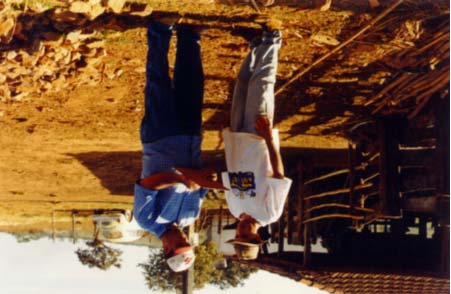
The Prefecture of Luz was the great partner, making the actions possible with the help of its
employees and operational structure. At the beginning of the Activity, the Offices of
Environment, of Social Services and of Education got involved, committing to the
implementation of the proposed actions and with the ones under way, being carried out by the
community.
2.2 INVOLVEMENT OF THE RURAL COMMUNITY
The rural zone of the Municipality is divided into several communities, far away from each other.
In view of these distances, cadastration activities became the initial step in community
mobilization, permitting the understanding of the social, economic and environmental reality of
the local countryside.
Picture 2. Cadastration of farmers, in Luz (MG)
For implementing the register, a cadastration form was created, containing information on the
properties, on the soil uses, on the destination of the water, on riparian woods (for properties by
water courses or lakes), as well as the environmental perception of the owner. Additionally, the
register contains information on the access to the property, including its sketch. Once the form
was ready, field surveys began, focusing on registering farmers in different areas of the
Municipality, to provide a better understanding of the local reality.
It is important to emphasize here the worry of the farmers in receiving the participants in the
Activity, especially those farmers with properties in the more remote sectors and with a lower
degree of instruction. It was thought that the technicians came to the properties with the purpose
of fiscalizing it. Cadastration was useful in breaking the common resistance of the farmers to
iv

participate in projects which require the use of their land, even though that is for their own
benefit.
At the time of the cadastration, some partnerships were made with those farmers who were more
receptive to the project's activities. It should be mentioned that some farmers, after reading the
terms of the agreement, preferred not to sign it, afraid they could be penalized for some reason. In
view of the situation, some of them received seedlings, even not signing the term, as they were
anxious to participate. That worry resulted from lack of instruction and/or distrust in the Project.
Another form of involvement of the community was through implementation of a campaign for
collecting seedlings of native species, with the participation of farmers and representative
institutions. With the support of the Rural Patronal Syndicate of Luz and of the Agriculture and
Livestock Raising Credit Cooperative, access to the farmers became easy.
Figure 2. Logo for the seedling collecting campaign.
The calling for participation in the campaign consisted of informative brochures mailed along
with the bill for milk from the cooperatives, letters from the Rural Syndicate, speeches of the
Credit Cooperative in the communities and radio callings, informing the places where the
seedlings were to be delivered. The campaign was successful and obtained great public
participation, resulting in a great production in the nursery.
Viewing the support of the farmers, in preparing for the capacitation on soil conservation and
reconstitution of riparian woods, it was taken advantage of the community meetings. These
meetings happen monthly, organized by the association of farmers of the respective communities.
Considering the already programmed dates, invitations were sent to the farmers, for a discussion
on soil conservation, to occur in the same day of the scheduled meeting.
v
In addition to that, invitations were sent to the farm owners, by the Agriculture and livestock
Raising Cooperative of Luz, along with the invoices of the institution, in an effort to reach a
greater number of persons and provide a firmer support to the activity. The Enterprise for
Technical Assistance and Rural Extension (EMATER) also sent invitations to the registered
farmers. The meetings were also announced by the local radio stations, with calls for the
meetings in each community. Given all the above, the number of participants was significant.
Figure 3. One of the invitations to the Community meetings.
2.3 INVOLVEMENT OF THE URBAN COMMUNITY
The methodology chosen for the mobilization and capacitation was the environmental education
of the public, with the objective of obtaining, from each one's knowledge and principles, the
motivation to contribute for the reconstitution of those environments, extremely necessary to the
maintenance of life in the planet.
The implemented meetings, courses, trainings, field days, fairs and workshops lead to a
discussion and reflection on the environmental problems and on the learning of facts that support
the values and actions that favor the exercise of citizenship.
In a meeting with all segments of the society, it was adopted an strategy of first exposing ideas,
and then passing to discussion in group. Viewing the mobilization and the organization of
CODEMA (Environmental Development Municipal Council), there were meetings with
community leaders, workshops for assessment of the local reality, public discussions about local
regulations, meetings for mobilization of principals of eight schools and presentations for 3,215
students. Through the Catholic and Evangelic Churches, with the efforts of priests and reverends,
it was achieved the involvement of the citizens. Participation of all of those segments permitted
vi
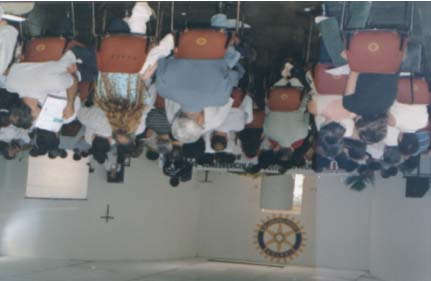
the elaboration of a list of identified priority problems and a proposal to start the mobilization of
the community to deal with these issues.
Picture 3. Community meeting, with participation of all segments of the society.
3. CAPACITATION
Activity 2.2.B, considering the knowledge of the local reality, contemplated the need to create a
program for the capacitation of the diverse segments of the society, viewing the sustainable
development. Thus, some techniques were passed to rural workers, aiming at the reclamation of
natural environments and at soil conservation.
Audio-visual means were used to get the attention of the farmers, getting them aware of the
importance of soil conservation. Conservation practices were demonstrated, as well as the
consequences of not adopting them. Well succeeded examples of terraces and contour lines,
showed the benefits of those practices.
3.1 CAPACITATION ON SOIL CONSERVATION
The farmers were trained in techniques for demarcating contour lines, using a device called
crows' foot, with the support of agriculture technicians. The Idea was to work with farmers with
a leadership over the communities, who would spread the learned techniques. Terraces were
prepared in the areas limited by the contour lines, demarcated with the crows' foot and with the
equipment of the Project, with each step being monitored by the farmers.
Terraces were made even in pasture areas already with a high degree of degradation, in a way to
permit the control of the erosion. This practice was implemented in 675 ha in the properties
within the Municipality.
vii
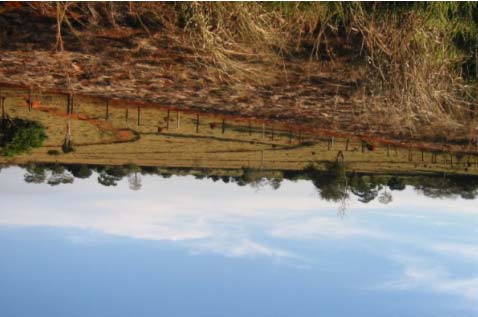
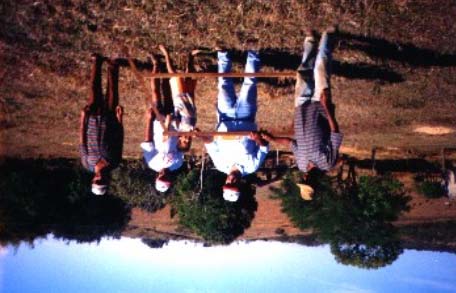
Picture 4. Flat terraces in Guarin Caetano's farm.
3.2 CAPACITATION ON RECONSTITUTION OF RIPARIAN WOODS
Reconstitution of riparian woods was attractive to the farmers. Its relevance was emphasized to
prevent the reduction in the availability water, which is currently occurring in the Region,
especially in the springs supplying water to the properties. Another determinant factor for the
achieving awareness and changing behaviors was the enforcement of the existing environmental
laws, by the competent agencies.
Picture 5. Training in contour lines demarcation, with the use of the crows' foot.
viii
3.3 CAPACITATION OF INSTRUCTORS
The community of Luz was very perceptible of the environmental problems, which are taking
huge dimensions. However, it was soon noticed by the diverse segments the difficulty to find
solutions. There was a lot of information, but confused and unorganized.
Three distinct groups of the urban society were trained: teachers, public employees and children
subject to social risks. The methodology was also focused environmental education of the public,
contemplating seven themes:
I. Our
environment.
II.
Our environmental knowledge.
III.
Ourselves as the environment.
IV.
How do we relate to nature?
V.
Our development model and the environment.
VI.
Improvement of our environment.
VII.
Our Project to improve the environment.
The environment is the transversal issue of the National Education Program. However, all
teaching units face the same difficulty: The lack of qualification of the teachers to deal with the
issue, besides the lack of informative material on local and regional problems. The existing
literature almost invariably approach the macro problems in a universal or national level. This
was the reason for the success of the course, which had the participation of all schools,
represented by a number of teachers proportional to the size of the school.
The capacitation of instructors aimed at preparing them to be multipliers, along with the teaching
body of their respective institutions, getting them apt to teach the course, meeting the demands of
each school. Given the overwhelming enthusiasm of the 42 participants, it was agreed that, if the
Superintendence of Education were in favor, the method would be passed on to every one of the
employees in the sector of education.
The program was elaborated and the tasks divided among the 42 teachers who had participated in
the initial course. All the material and personnel required for the proper implementation of the
activities in the course were provided. After approval by the secretary of Education and
Superintendence of Teaching, the course was given to 275 employees of the sector, in two days.
The work was a success.
ix
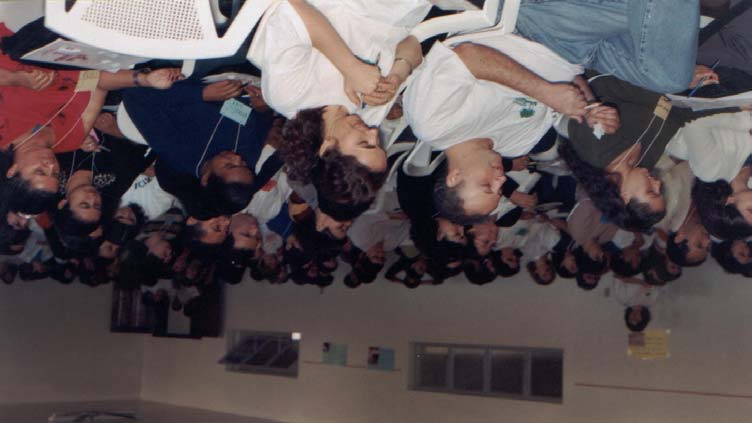
3.4 TRAINING OF THE SMALL ENVIRONMENTAL TECHNICIANS
The work also reached the children subject to social risks, who received especial training, being
personally monitored, receiving orientation in their work at school work and implementing
activities which would awaken them for the local environmental issues. Many of the activities in
the municipality were implemented with the involvement of this group, what resulted in an ample
acceptance of the project and in the implementation of participative actions in the community.
Picture 6. Participants in the reposing of the course.
3.5 TRAINING OF PUBLIC EMPLOYEES
Tem public employees, who had an important role in the multiplication of the information and
worked directly with mobilization, along with the consultants, were also trained. Matters of the
Project and technical information on the methodology to be adopted in the mobilization,
reconstitution of riparian woods and soil conservation were discussed in the course.
4. PRODUCTION OF FOREST EXTRACTS
4.1 PRODUCTION OF NATIVE EXTRACTS FOR RECONSTITUTION OF
RIPARIAN WOODS.
All the work to involve the community was focused on the rescue of citizenship, leading to a
reaction in face of the picture of degradation in the Municipality, with actions for recovering
natural environments. Reconstitution of riparian woods needed further investigations for better
knowledge of the local flora and for the identification of matrices for collecting the seedlings, as
well as for their production in nurseries, for posterior planting, viewing the reconstitution of the
riparian environments.
x




Picture 7. Riparian woods in the São Francisco River, in the Municipality of Luz.
The native vegetation cover in Minas Gerais was eliminated by agricultural and livestock raising
activities and particularly by siderurgy. With regard to riparian woods, especially in the São
Francisco River Basin, degradation came to a point of almost completely extinguishing some
species. For many of those species, there are no longer plants which could serve as a matrix for
their reproduction. It is necessary to import seeds from places frequently far away, in National
Parks and/or other reserves. These difficulties are obstacles to the quality of the work under way.
Given that there is little left of riparian woods in the Upper São Francisco, the degree of difficulty
increases when there is attempt to make an inventory of native species and to evaluate their
distribution and frequency of occurrence, And those are critical information for the elaboration of
an adequate program for reconstituting natural environments.
Activity 2.2.B initiated the study of the existing species in the Municipality, with the
identification of matrices, from which seeds should be collected for the production of seedlings,
to be used in the reconstitution of the ecosystems. This inventory is shown in Chart 1.
Seeds were collected in Luz and in adjacent Municipalities, especially in Lagoa da Prata. Many
fruit trees were introduced, with the objective of attracting birds, for their important seeding role,
in addition to being in the interest of some farmers, owners of small properties, even though that
strip of land was previously used for production, thus affecting their economy. This way, many
barriers were removed and adhesion to the program grew.
xi
Chart 1. Arboreal species identified in the Urubu Riparian Forest (Lagoa da Prata) and in
the Bodão Farm (Luz), with ecological classification based on the growing
strategy (PI=pioneer, CS=secondary, CL=climax) and with size in the adult
phase (AA=high, AB=low, AV=arboreous).
Family / Species
Popular names
Ecological Class
Size when adult
ANACARDIACEAE
Astronium fraxinifolium
gonçalo-alves
Cl
AA
ANNONACEAE
Xylopia aromática
pimenta de macaco
PI
AB
Xylopia emarginata
Pindaíba do brejo
PI
AA
APOCYNACEAE
Aspidosperma
rose peroba
CL
AA
cylindrocarpon
guatambu
CL
AA
Aspidosperama parvifolium
ASTERACEAE
Vernonia polyanthes
assa-peixe
PI
AB
BIGNONIACEAE
Jacaranda brasiliana
Caroba
CL
AB
BIGNONIACEAE
Tabebuia impetiginosa
ipê roxo
CL
AA
BOMBACACEAE
Erioteca gracilipes
silk cotton tree
CL
AB
CAESALPINIACEAE
Bauhinia sp
unha de vaca
PI
AB
Copaíba langsdorffi
pau-d'óleo
CS
AA
Hymenae pubescens
jatobá-peludo
CL
AA
Hymenae courbaril
jatobá
CL
AB
Senna multijuga
canafistula
CL
AB
Senna reticulata
wood sorrel
CL
AB
CELASTRACEAE
Maytenus robusta
coração-de-bugre
CL
AB
CHRYSOBALANACEAE
Hirtela glandulosa
olive tree
CS
AB
COMBRETACEAE
Terminalia glabrescens
mirindiba
CL
AA
Terminalia phaeocarpa
capitão-da-mata
CL
AA
EBENACEAE
Diospyros híspida
oxeye
CL
AB
ERYTHROXYLACEAE
Erytroxilum citrifolium
jiriti fruit
CS
AB
Erytroxilum cuneifolium
baga-de-pomba
CL
AV
Erytroxilum deciduum
cocão
CL
AB
xii
Family / Species
Popular names
Ecological Class
Size when adult
FABACEAE
Dipteryx alata
baru
CL
AA
Machaerium amplum
amoroso
CL
AA
Machaerium opacum
field rosewood
CL
AB
LYTHRACEAE
Lafoensia pacari
dedaleiro
CL
AA
MALPIGHIACEAE
Byrsonima cydonifolia
canjica
CL
AV
MELIACEAE
Trichilia sp
catiguá
CS
AB
MIMOSACEAE
Albizia niopoides
farinha seca
CL
AA
Albizia blancheti
bean tree
CL
AA
IMOSACEAE
Anadenanthera calubrina
white angico
PI
AA
Anadenanthera peregrina
red angico
PI
AA
Chloroleucon tenuiflorum
pau cascudo
CL
AA
Dimorphandra mollis
faveleira
CL
AV
Enterolobium contortisiliquum tamboril
CL
AA
Inga sp
inga
CL
AA
Mimosa pigra
arranha-gato
PI
AV
Piptadenia gonoacantha
pau jacaré
PI
AA
Plathymenia reticulata
Brazilian mahogany
CL
AA
MORACEAE
Fícus obtusiuscula
water fig tree
CL
AA
Fícus gomeleira
mata pau
CL
AA
Maclura tinctoria
moreira
CL
AA
MYRTACEAE
Eugenia Pitanga
Surinam cherry
CS
AB
Eugenia stictosipala
castor oil plant
CL
AA
Myrcia tomentosa
wild guava
CL
AB
Myrcia sp
guava
PI
AB
Psidium guíñense
black guava
CL
AB
PAPILIONOIDEAE
Erytrina falcata
coral tree
CS
AV
Andira anthelmia
angelim-amargoso
CS
AV
RUTACEAE
Zanthoxyllum rhoifolium
mamica de porca
CL
AA
SAPINDACEAE
Magonia pubescens
tingui
CL
AA
Matayba sp
guara tree
CS
AA
Talisia esculenta
pitomba
CL
AA
xiii
Family / Species
Popular names
Ecological Class
Size when adult
SAPINDACEAE
Matayba elaeagnoides
pau-pombo
CS
AA
SAPOTACEAE
Pouteria torta
grão de galo
CL
AA
STERCULIACEAE
Guazuma ulmifolia
bastard cedar
CL
AA
Sterculia striata
chichá
CL
AA
TILIACEAE
Luehea peniculata
açoita cavalo
CL
AA
ULMACEAE
Trema micrantha
grandiuba
PI
AB
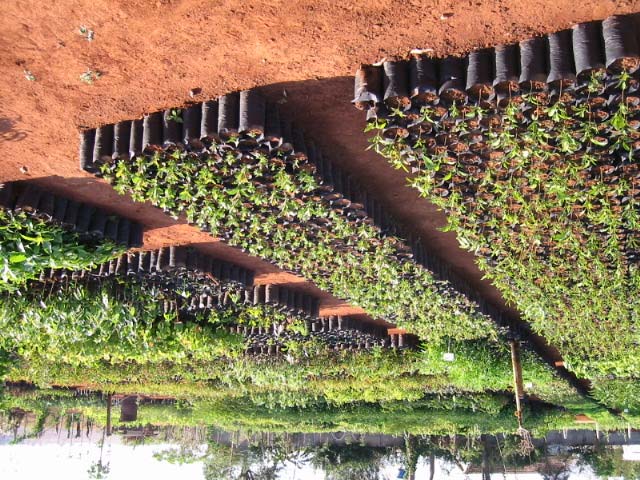
The produced seedlings are meant for the reconstitution of the riparian woods of the São
Francisco River and its tributaries, within the Municipality, and creation forests with economic
purposes. They were produced predominantly in the Prefecture's nursery, with capability of
producing up to 200,000 seedlings.
Picture 8. Nursery with native Forest extracts.
xi v
However, there is no infrastructure to reach that full potential: 100,000 seedlings of native
species were produced, for reconstitution of riparian woods, in addition 25,000 seedlings of
eucalyptus. CEMIG (Electric Company of Minas Gerais) contributed with 10,000 native species
seedlings and additional 45,000 eucalyptus were purchased, to meet the demand created by the
partners of the Project.
4.2 PRODUCTION OF EXOTIC SPECIES
Seedlings of the predominant native species in the regional ecosystem are used fore reconstituting
riparian forests, while eucalyptus are preferred for the formation of economic forests. The latter is
usually used for coal production and for lumber to be used for diverse purposes in the rural
properties. Additionally, the excess may be sold for complementing family income. The objective
of an economic forest is to provide for the basic farmers' needs, reducing the pressure on forests
in permanently protected areas.
5. IMPLEMENTATION OF CONSERVATION PRACTICES
5.1 SOIL CONSERVATION PRACTICES
The basic economic activities of the Municipality of Luz relies on agriculture, mainly with corn,
soybean and green vegetables, in dark red latosols and cambisols with silty textures. Exploitation
occurs predominantly with the use of agriculture machinery and implements, which sometimes
revolve the soil and expose it to the effect of the water.
The rainfall regime, concentrated in a period of the year, in addition to the susceptibility of the
soil and inadequate use of the land, contribute to the erosive processes. Besides, the Municipality
is spread over areas with irregular relief, with 60% corresponding to wavy and/or mountainous
forms (IGA/CETEC), which also favors soil degradation, by erosion.
Erosion contributes to reducing the production capacity of the soils, impeding incorporation of
fertilizers and corrective products. Another contribution, perhaps the most important, is the
deposition of sediments in the streambeds. For this reason, soil conservation practices acquire
great importance in the conservation of water and in savings in agricultural and livestock raising
activities.
The soil conservation technique taught and practiced was that of construction of flat terraces,
with strips of land, transversal to the direction of the flow of the drained rainfall. This reduces
both the velocity of the flow and the transport of nutrients and soil particles.
For this reason, capacitation of farmers in conservation practices is top priority. There were
trainings in terrace demarcation techniques, using the crows' foot device, with the support of
agriculture technicians. Efforts were made to work with farmers with a leadership over the
community, so that they would disseminate the learned practices, and with those who were
willing to work abiding by the objectives of the Project.
xv
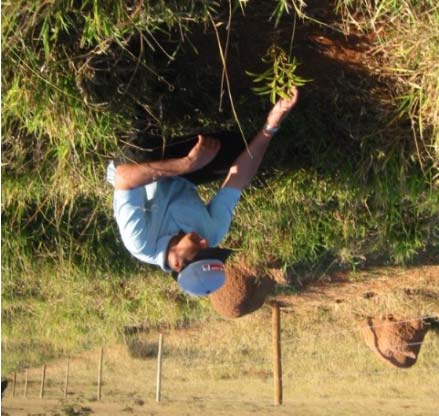
5.2 RECONSTITUTION OF RIPARIAN FORESTS
Reconstitution of riparian forests was accomplished through a partnership established among the
Subproject and the farmers. Besides technical assistance and monitoring of the activities, the
Project provided material for isolating the area to be worked on (fence stakes), appropriate
seedlings and pesticides for ant control.
The farmers were made aware of the importance of the riparian vegetation for the regime of the
streams within the properties and for the entire environment. The seedlings were distributed
among the farms according to the size of the area to be reconstituted and the farmers were
instructed on the methodology to be adopted for the task.
Planting in the permanent protection areas was in compliance with the Forest Code (Law
4771/65). However, in many places, negotiations were necessary with small farmers, in order to
make possible the reconstitution. In some cases, fruit trees were also planted to make it more
attractive to the farmers whose areas were being used for production.
Each farmer compromised to taking care of the seedlings and making fences, in addition to using
the provided material for their protection. A total of 62,179 seedlings of native species were
distributed, corresponding to an approximate area of 39 ha, considering an average spacing of 2.5
meters between adjacent seedlings.
Picture 9. Planting seedlings of native species.
In view of the involvement of the community, there was a hike in the interest in the Project, even
with demands for effectively participating in the activities. The gratuitous participation of the
entire community in the planting was a consequence of this interest, counting with the help of the
local school, which helped in the Activity in all of its stages.
xvi
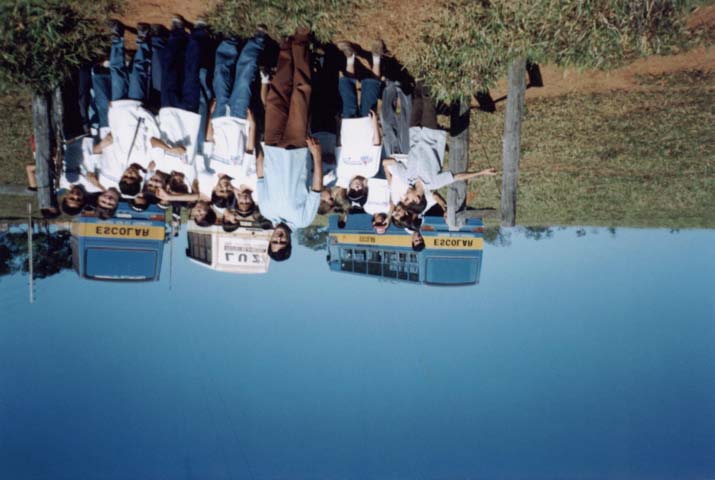
All the 600 students of the Dom Manoel Municipal School (elementary and high-school level)
participated in the work, with 300 of them planting 200 ornamental species in the school garden
and the other 300 planting 1,500 native species seedlings at the headwaters of the Guarin Lagoon.
The students were previously prepared for the planting, receiving instructions on the techniques,
especially on the way to distribute the seedlings in the area according to the quincuncial
arrangement. They were also made aware of the need to collect the garbage and using the urban
solid wastes collection system. The time for the training was considered as a field class, prior to
the planting activities.
The 300 students were distributed in groups of 30, each of them with a monitor, to conduct the
activities at all times. The holes for planting were prepared in advance and the seedlings
distributed by the places they were supposed to be planted. Each student planted around five
seedlings, picked up the plastic wrappings and took them to be deposited in the garbage
containers placed all over the area.
Picture 10. Students during the community planting.
5.3 PLANTING EXOTIC SPECIES
With the widespread deforestation in the Municipality, viewing the expansion of agriculture and
livestock raising, the farmers have endured the lack of lumber for their own use (isolation of
sectors, stakes for restoration of fences, lumber for the corrals and roofs). With the situation, the
few preservation areas have been under pressure by the impoverished farmers who, many times,
do not find alternative ways to fulfill their needs.
The establishment of these areas aim at meeting the rural land owners` needs of lumber, thus
assuring the preservation of the legal reserves (defined by the Forest Code as 20% of the
properties) and of the permanent protection areas.
xv ii
Eucalyptus (Eucalyptus urophylla) was chosen for establishment of the economic forests, in view
of its great availability in the Brazilian market and for the advantages it offers, with emphasis to
its quick growth, allowing the first cut after three years, and vast utilization.
Part of the seedlings were produced at the Prefecture's Municipal Nursery and part was
purchased from the Santa Bárbara Agro-Forest Company (CAF Santa Bárbara), in the neighbor
town of Bom Despacho. The acquisition of seedlings was necessary to overcome the insufficient
production capacity of the local nursery, as well as to diversify their source. With this, the
farmers acknowledged other places for acquiring seedlings, as they are produced in small
quantities at Luz.
For planting the eucalyptus, areas with less intense activities were selected in each farm (usually
those with poorer soils and steeper slopes), keeping a distance from the water courses. Through
the capacitation program, farmers were trained in methods for planting and caring for the
seedlings, to assure a perfect development of the plants. To complete the process, material was
provided to help in their maintenance.
6. STRENGHTENING OF LOCAL ORGANIZATIONS
In all stages of development of Activity 2.2.B, local organizations, such as the Agriculture and
Livestock Raising Production Cooperative of Luz, the Rural Patronal Syndicate of Luz, SEBRAE
and the Development Agency of Luz (ADLUZ), participated actively. This participation
strengthened the organizations in front of the community, considering that the implemented
actions contributed significantly to the municipal sustainable development.
The public institutions, such as EMATER (Technical assistance and Rural Extension Enterprise
of the State of Minas Gerais), the Agriculture and Livestock Raising Institute of Minas Gerais
and the Municipal Prefecture of Luz, became closer to the population. Throughout the process,
the implementation of the work improved the relation between technicians and the community.
This way, the agencies had the opportunity to show their role and attributions to the community,
increasing their credibility with the citizens.
By their turn, organizations like the Environmentalist Association of the Upper São Francisco
and the College of Philosophy and Letters of the Upper São Francisco also made efforts and
proved to the citizens the importance of their participation. Many works resulted from local
initiatives, not foreseen by the Project, but encouraged by the community involvement. Projects
previously in storage by the community started to be reviewed and implemented, recovering a
possibility of partnership and the assurance that it is possible to implement important action with
the commitment of everybody.
With this, local organizations were strengthened and other initiatives by community
organizations began to be discussed and implemented, in some cases, as the selective collection.
xv iii
7. CONCLUSIONS
FOREST DEGRADATION
Environmental degradation is evident, especially with respect to deforestation of riparian areas
and acceleration of the erosive process. It is noticed that this situation is further aggravated in
small properties, where farmers, lacking capital and knowledge, look for more fertile areas and
for lumber, in the remaining woods.
COMMUNITY MOBILIZATION
The great involvement of the community in the Project was determinant, contributing to the
accomplishment of some goals. Activity 2.2.B implemented some activities which provoked the
involvement and commitment with actions aiming at environmental conservation and
reconstitution. The participative environmental education methodology achieved good results,
using the popular knowledge at several moments, which contributed to increase the interest for
the matter and especially to improved results.
All educational segments, rural class entities, organized community and social and religious
groups who were heard and asked to participate as partners in this innovative proposal, aimed at a
change from a predator behavior to a commitment with natural resources sustainability, answered
affirmatively. There was a willingness to change the environmental degradation picture and the
impoverished condition of the farmers and this was an opportunity to review the deep-rooted
attitude of the population.
Cadastration was a valuable tool for acknowledging the reality of the Municipality, mainly
because it showed the situation of the environment in rural areas and how environmental matters
are dealt with. Based on the 150 registered farmers, it might be known what they think and how
they behave with respect to the environment and to conservation and soil management practices.
Another important issue revealed by the cadastration was the diversification of situations in the
Municipality, such as the verification that large properties are usually located in more fertile and
flat lands, while there is a great density of properties in poorer ranges with a more irregular relief.
This latter situation contains the majority of the springs in the Municipality.
It is clear the dissatisfaction of the community in face of the prospect in which it perceives its
impoverishment. However, many times, people are unaware of the reasons for this
impoverishment and get confused, what contributes to the maintenance of traditional practices,
used by many generations. The participating group gave emphasis to the importance of
capacitating several actors, fulfilling well its role of multiplier. However, it is known that
education is a continuous process and needs time to achieve the desired results of behavioral
changes.
xi x
CAPACITATION
Holding farmers' meetings in the small communities in scheduled fixed times was decisive for
people attendance and participation. This was due to distance shortening, but mostly because it
eliminated the initial concern regarding to the capacitation itself and the presence of strange
people. This was a really common concern among farmers with low literacy.
From all methods of approach, the most important activities and the ones which attracted the
greatest attention were the practical activities, in which the farmers dirtied their hands, such as
demarcation of contours and planting of seedlings. At the end, many had the opportunity to learn
and to spread what they learned to neighboring farmers, as they learned doing it.
The farmer capacitation strategy proved to be very efficient, reaching 137 properties. The use of
audio-visual means, besides being attractive to the farmers, for presentation of the problems
accruing from inadequate soil use and of the destruction of riparian woods, was relevant to the
success of the process.
The training of instructors was efficient in multiplying the information and the results exceeded
the expectative. The first of them was the creation of a Permanent Environmental Education
Fórum. This group, formed by representatives from all schools in the Municipality (eight
altogether), aimed at the monitoring and the continuity of the environmental education, going
beyond the limits established by the school walls, to reach the community.
As a result of the organization of the Forum, it is emphasized the repassing of the course to
professors of the public and private schools in the Municipality, reaching 275 professionals,
including professors, school principals, supervisors and janitors. They all had Access to relevant
information, the opportunity to exchange experiences and to discuss issues of great interest to the
community.
Implementation of several works developed in the schools provoked the involvement of 3,215
community students. The environmental fair was an excellent example, constituting a moment of
great mobilization. All citizens were able to meet, get information and to participate, contributing
to the movement for awareness of the sustainable development of the Municipality.
PRODUCTION OF FOREST EXTRACTS
In order to produce adequate species for the reconstitution of the natural environment and to
assure its development, it is necessary to make an inventory of the plants occurring in the
Municipality and in the Region (31 of them were registered and worked upon). Production of
native seedlings must consider the greater possible number of species, which requires the
capacitation of nursery workers and seed collectors. This type of work requires specific treatment
for each of the species.
Community participation in the phase of production of the native seedlings in the municipal
nursery, through a campaign of seed collection, intensified the contact among farmers and, as a
xx
consequence, increased the demand for seedlings. A total of 62,179 native seedlings and 40.200
eucalyptus were planted.
IMPLEMENTATION OF CONSERVATION PRACTICES
The stage of construction of terraces is inserted in the soil conservation activities, which aims at
repassing the practice to the farmers. The objective of this activity is more than just building
terraces, as the area covered by the Activity (675 ha) is small, compared to the entire
Municipality. The interest of the Project was that the presented soil conservation practices were
learned and used by the farmers, as sustainable production techniques.
It is evident the lack of adequate machinery in the prefectures and rural organizations, for a
permanent and efficient work aimed at soil conservation.
Putting together environmental conservation and activities with an economic return is an efficient
motivation instrument, for farmers' participation. Creation of economic forests reduces the
pressure on the remaining riparian woods and legal reserves and, consequently, on the soil and
water conservation, thus assuring greater water availability, especially in the springs.
Protecting areas with fences, even with a high index of losses of seedlings, increases the chances
of a natural reconstitution. The spreading of seeds by birds, animals and even by floods that
convey seeds from remote places, happen in greater or smaller proportions, according to the
diversity of the neighborhood. Areas with occurrence of matrices, even though isolated, should
be fenced to assure the development of plants that sprout naturally in the place.
The communitary planting of seedlings involved 300 students, who planted 1,500 plants. This
action committed the citizens to the environmental recovery proposal. After acknowledging the
matter theoretically, the opportunity to effectively participate in the planting reaffirmed the
learned subject and brought credibility, in addition to a possibility of changes in the picture of
degradation. All the students who participated in the communitarian planting of the riparian
woods began to act as guardians of the area, until its total reconstitution.
STRENGHTENING OF LOCAL ORGANIZATIONS
Partnership with farmers is an effective and efficient form of environmental reconstitution and
conservation. As the majority of the rural properties are small and suffer economic shortages,
those partnerships should be encouraged. The farmers would be committed to create and maintain
the reconstituted areas and, in return, they would receive seedlings, raw materials and technical
assistance.
It was tried to take into consideration the interests of the rural landowner in the negotiation
regarding the size and location of the area to be worked upon, always in compliance with the
legal and technical recommendations. This was the way to create the demonstration units
proposed in the objectives of the Activity.
xxi
The continuity and sustainability of the activities pass necessarily through the strengthening of
the local organizations. And those, committed to the maintenance of the Project, start to demand
from the public institutions investments in its continuity and even in the implementation of new
natural resources revitalization programs.
8. RECOMMENDATIONS
Based on the implemented activities and on the accomplished by the Activity, the following
recommendations are made:
RECOMMENDATION 1: Creation of a Participative Environmental Education Program
Much has been said in the media regarding environmental issues, in an attempt to bring
awareness to the population. However, there has been no success in changing behaviors.
Therefore, it is understood as necessary the creation of a participative educational program, to
obtain the commitment of the citizens to the social and economic issues.
Participative programs do not present previously prepared solutions for implementation, but raise,
together with the community, issues that represent annoyances and can be worked upon. The
process includes partnerships with public agencies, community social institutions and private
enterprises. They have the following objectives:
· Understanding the social and economic reality, based on the point of view of local people.
· Creating opportunities for discussing environmental problems raised by the local population
and those identified by the technicians.
· Presenting solutions for each problem and indicating the responsible parties for
implementation of the necessary actions.
· Making possible the development of participative actions.
· Establishing partnerships with local organizations to promote their strengthening.
· Disseminating the collected data and information, making them available for consultation.
PARTICIPATIVE ENVIRONMENTAL EDUCATION PROGRAM
COST ESTIMATES (US$ 1.00)
SPECIFICATIONS
Year 1
Year 2
TOTAL
Consultants 27,000
13,500
40,500
Daily allowances
7,000
3,500
10,500
Subtotal
51,000
xx ii
Office material
2,300
1,125
3,425
Equipment 13,300
-
13,300
Subtotal
16,725
Maintenance of vehicles
500 500
1,000
Third party contracts (enterprises)
9,740
-
9,740
Third party contracts (individuals)
3,600
1,800
5,400
Workshops 3,300
1,500
4,800
Subtotal
20,940
TOTAL
88,665
RECOMMENDATION 2: Creation of a Bank of Seeds of Native Species
Knowing the environmental reality of the São Francisco River Basin, it has been understood as
extremely necessary the intervention of man for its conservation and reconstitution.
A critical factor in this context is the small number of some species found in these areas, due to
the uncontrolled deforestation verified along the River, through the years. In view of this, if the
production of seedlings is to be restricted to local collection, from the same matrix, there is a risk
of degeneration of the species. Thus, with the creation of a bank of seeds, there will be an
exchange of seeds from diversified sources, which will assure a greater genetic diversity.
The proposed recommendations aim at:
· Implementation of three banks of seeds of native species throughout the Basin and support to
the production of seedlings in the nurseries, with a greater diversification of species adequate
for reconstitution of riparian environments. The areas served by each bank are to be defined
by studies of the Basin`s ecosystems.
· Establishment of exchanges among nurseries, encouraging environmental activities for the
reclamation of degraded areas and reconstitution of riparian environments of the São
Francisco Basin.
CREATION OF A BANK OF SEEDS OF NATIVE SPECIES
COST ESTIMATE ( US$ 1.00)
SPECIFICATIONS
Year 1
Year 2
TOTAL
Consultants 64,300
53,500
167,800
Daily allowances
13,125
7,375
21,000
Subtotal
188,800
Office material
3,608
3,609
7,217
Equipment 21,700
-
21,700
Subtotal
28,917
Maintenance of vehicles
500
500
1,000
xx iii
Third party contracts (enterprises)
25,200
-
25,200
Third party contracts (individuals)
6,000
6,000
12,000
Subtotal
38,200
TOTAL
255,917
xxi
v